
Everyone is using AI. Almost no one is adopting it.
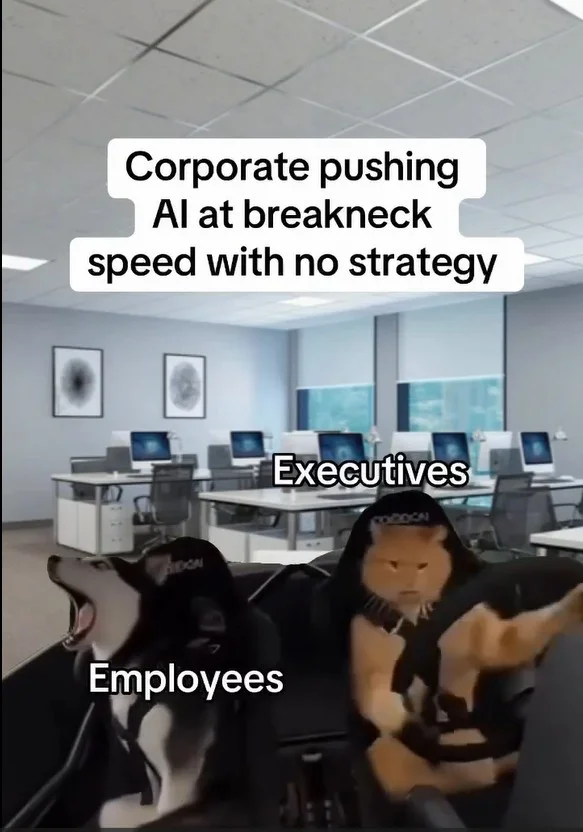
Here is something that is true of almost every business right now, whether leadership knows it or not.
Your people are already using AI.
Someone in finance is pasting a report into a chat window to get a summary. Someone in sales is drafting a proposal with it. Someone is tidying up an email before it goes to a client, or a regulator, or the board. Nobody approved this. Nobody is measuring it. And nobody is asking where that information goes once it leaves the building.
This is not adoption. This is a habit. A private, invisible, unmanaged habit.
And it creates two problems at the same time.
The first is risk. Your staff are feeding customer details, contracts, and internal numbers into tools the business has never reviewed. No policy. No oversight. No record. The exposure is real, and most leadership teams have no idea it is even there.
The second is that you are getting almost nothing back. Rewriting a paragraph. Fixing a tone. Summarising a page. Useful, but small. There is no automation. No productivity gain anyone can measure. No strategy connecting any of it to the actual business. The tool is treated as a personal convenience, not a business capability.
So you carry all of the risk and capture almost none of the reward.
That is the adoption gap.
Closing it is not a launch. You do not buy a tool, send a memo, and declare victory. It is a loop. Three steps, and you keep running them.
1. Learn
Everyone learns. Formally. And it starts at the top.
The board does not need to write prompts. It needs to understand what this technology can and cannot do, well enough to govern it and fund it properly. Senior management needs enough fluency to see the opportunities and set the guardrails. The teams doing the actual work need hands-on training on the actual tools they will actually use.
Not a webinar. Not a lunch talk you forget by Friday. Real, structured learning, at every level, so the whole organisation is finally speaking the same language about what is possible. Skip this and everything after it is guesswork.
2. Adopt
Now you go looking. Not for places to sprinkle AI on top, but for the repetitive, high-volume, rule-heavy work where a person is doing something a machine could carry most of the way.
A few obvious ones:
- Drafting and reviewing routine customer replies
- Pulling data out of invoices, contracts, and reports
- First drafts of proposals and internal documents
- Triaging support requests and routing them to the right team
- Building the weekly report from data that already sits in your systems
Pick a few. Build a proper workflow around each one. Run it. See what breaks.
This is also where you bring in help. Forward-deployed engineers, consultants, people who have done this before and will save you months of guessing. Then you learn again, because every workflow you run teaches you something about the next one.
3. Scale
When a workflow earns its place, grow it.
More people. More teams. Stitch the small workflows into bigger ones. Move from assisting a single task to running a whole process. And measure the entire way, so you can point at a number instead of a feeling.
Then you go back to the start. Because scaling always exposes the next thing you do not yet understand, which sends you back to learning, which opens up the next place to adopt.
The point
AI is already in your business. The only real question is whether it stays a habit, or becomes a capability.
That is the whole game. And it is decided by the loop, not the tool. Learn, adopt, scale, and go again.

Comments
Be the first to comment.